
Disclosure: Wallstores is reader-supported. As an Amazon Associate, we earn from qualifying purchases made through links on this page, at no extra cost to you. Learn more.
How We Choose the Products We Recommend
We don’t have a warehouse full of gear to physically put through its paces — what we do instead is disciplined research. For every guide, we start with the manufacturer’s published specifications and compare them directly against competing models in the same price range. We track real, current pricing across retailers, not list prices that never actually apply, so the numbers in our comparisons reflect what you’d actually pay today. And we read, in bulk, through verified customer reviews and independent expert coverage for each product, looking for recurring complaints, common praise, and the patterns a single glossy product page won’t tell you.
Where we’ve personally bought and used a product ourselves — currently true for many of the kitchen items we cover — we say so directly in the review, and that firsthand experience shapes what we highlight. For everything else, our pros-and-cons calls come from that cross-referenced research process, not a single source or a rewritten spec sheet. We revisit guides periodically as prices shift and new models launch, and we link to multiple retailers where possible so you’re not stuck with just one option.

Ugo Daniel researches, compares, and writes the buying guides on Wallstores, cross-checking manufacturer specs, verified pricing, and real customer feedback across tech, home, fitness, and pet categories. He’s personally bought and used many of the kitchen appliances featured on the site, and draws on that firsthand experience in those reviews.
Last updated: November 2026 · Written by Ugo Daniel, founder of Wallstores
The most common space heater mistake is buying the wrong size. Too small, and it runs flat out all evening without ever warming the room. Too big, and it cycles on and off, wasting money and making the room uncomfortable. This guide shows you how to work out what size you need in a couple of minutes, using a tape measure and simple math.
The Quick Rule: 10 Watts per Square Foot
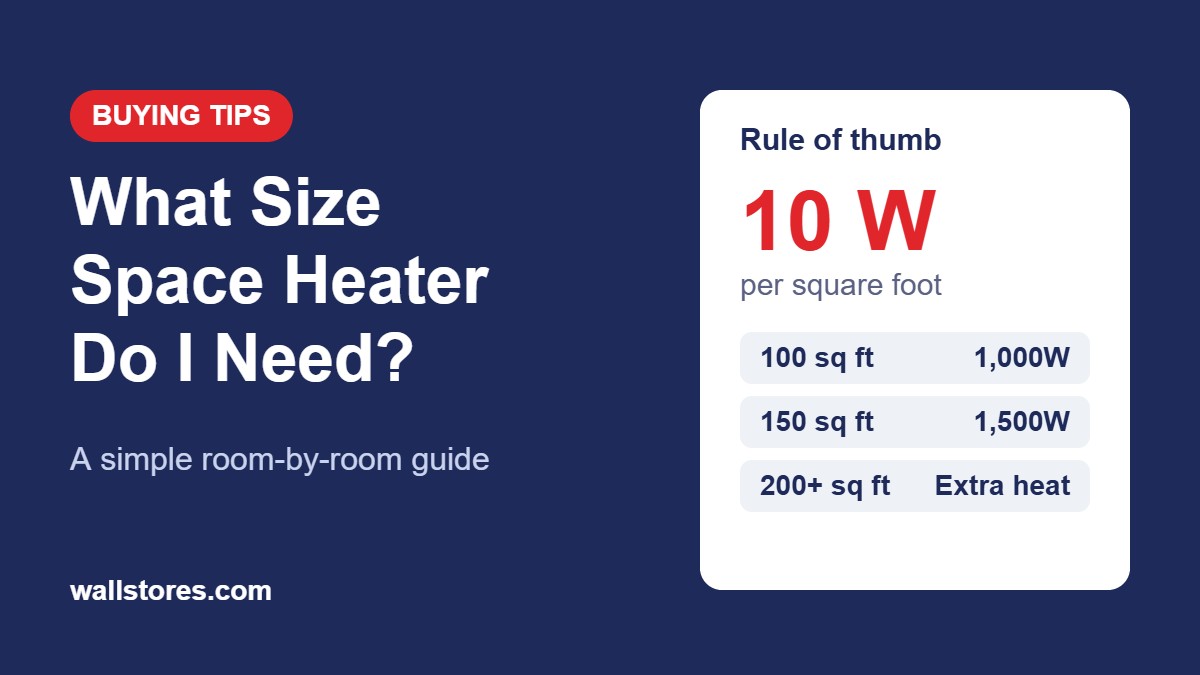
For a room with standard 8-foot ceilings and average insulation, plan on about 10 watts of heating for every square foot of floor space when the heater is your main source of heat in that room.
- Measure the room’s length and width in feet.
- Multiply them to get the area. For example, 12 ft × 12 ft = 144 sq ft.
- Multiply the area by 10. For example, 144 × 10 = 1,440 watts.
A standard 1,500-watt heater would suit that room. Most plug-in heaters max out at 1,500 watts, because that’s about the most a typical home outlet and circuit can safely supply to one appliance.
Room Size Chart
| Room size | Example | Heater size (main heat) |
|---|---|---|
| Up to 100 sq ft | Small office, bathroom | 750–1,000W |
| 100–150 sq ft | Bedroom, home office | 1,500W |
| 150–250 sq ft | Large bedroom, small living room | 1,500W as extra heat, or two heaters on separate circuits |
| 250 sq ft and up | Living room, open-plan space | Supplemental heat only; consider other heating for the whole room |
If the heater is only topping up central heating, a 1,500-watt model can comfortably take the chill off larger rooms than the chart suggests.
Adjust for Your Room
- High ceilings: heat rises, so taller rooms need more power. Multiply your watts by the ceiling height divided by 8. A 10-foot ceiling needs about 25% more.
- Poor insulation or drafty windows: add 20–30%, or better yet, seal drafts first. It’s cheaper than buying a bigger heater.
- Very cold climate: rooms over unheated garages or with several outside walls need more heat than the rule suggests.
- Well-insulated, newer homes: you may need less.
Watts vs. BTUs
Some heaters list output in BTUs (British thermal units) instead of watts. To convert, multiply watts by 3.41. A 1,500-watt heater produces about 5,100 BTUs per hour. All electric heaters turn almost all of the electricity they use into heat, so a 1,500-watt heater of any type puts out about the same amount of heat. What changes is how that heat reaches you.
Which Type of Heater for Which Room?
| Type | How it heats | Best for |
|---|---|---|
| Ceramic fan heater | Blows warm air | Quickly warming small rooms and offices |
| Oil-filled radiator | Slow, steady radiant warmth; silent | Bedrooms and rooms where you’ll stay for hours |
| Infrared / radiant | Warms people and objects in front of it | Drafty spaces and spot heating at a desk |
| Tower heater with oscillation | Spreads warm air across a room | Living rooms and larger spaces |
Bigger Isn’t Always Better
A heater with a built-in thermostat is more important than raw wattage. It switches the heating element off once the room reaches your set temperature, which saves electricity and keeps the room comfortable. A heater without one runs constantly until you turn it off.
If one heater can’t keep up, don’t plug two into the same circuit. Two 1,500-watt heaters on one 15-amp circuit will trip the breaker. Use outlets on different circuits, or look at other heating options for that room.
Safety Checklist
- Choose a heater with tip-over and overheat protection, and a UL or ETL safety mark.
- Keep at least 3 feet of clear space around it.
- Plug it directly into a wall outlet, never into an extension cord or power strip.
- Don’t leave it running unattended or while you sleep, unless the manufacturer specifically says it’s designed for that.
- Keep it on a hard, flat floor, not on rugs or furniture.
What It Will Cost to Run
A 1,500-watt heater on full power uses 1.5 kWh per hour, about 26 cents an hour at $0.17 per kWh. With a thermostat cycling it on and off, real costs are usually lower. Our space heater vs. heated blanket running-cost guide has full daily and monthly figures, and shows when heating yourself is cheaper than heating the room.
Frequently Asked Questions
Can one space heater heat a whole house?
No. Space heaters are designed for single rooms. Heating a whole house this way is expensive and can overload circuits.
Is a 1,500-watt heater enough for a bedroom?
For most bedrooms up to about 150 square feet, yes, especially with a thermostat.
Do higher-wattage heaters exist?
Yes, but they usually need a dedicated 240-volt circuit installed by an electrician. Standard plug-in heaters top out at 1,500 watts.
Ready to compare models? See what to consider before buying a space heater.
Ugo Daniel researches, compares, and writes the buying guides on Wallstores, cross-checking manufacturer specs, verified pricing, and real customer feedback across tech, home, fitness, and pet categories. He’s personally bought and used many of the kitchen appliances featured on the site, and draws on that firsthand experience in those reviews.