
Disclosure: Wallstores is reader-supported. As an Amazon Associate, we earn from qualifying purchases made through links on this page, at no extra cost to you. Learn more.
How We Choose the Products We Recommend
We don’t have a warehouse full of gear to physically put through its paces — what we do instead is disciplined research. For every guide, we start with the manufacturer’s published specifications and compare them directly against competing models in the same price range. We track real, current pricing across retailers, not list prices that never actually apply, so the numbers in our comparisons reflect what you’d actually pay today. And we read, in bulk, through verified customer reviews and independent expert coverage for each product, looking for recurring complaints, common praise, and the patterns a single glossy product page won’t tell you.
Where we’ve personally bought and used a product ourselves — currently true for many of the kitchen items we cover — we say so directly in the review, and that firsthand experience shapes what we highlight. For everything else, our pros-and-cons calls come from that cross-referenced research process, not a single source or a rewritten spec sheet. We revisit guides periodically as prices shift and new models launch, and we link to multiple retailers where possible so you’re not stuck with just one option.

Ugo Daniel researches, compares, and writes the buying guides on Wallstores, cross-checking manufacturer specs, verified pricing, and real customer feedback across tech, home, fitness, and pet categories. He’s personally bought and used many of the kitchen appliances featured on the site, and draws on that firsthand experience in those reviews.
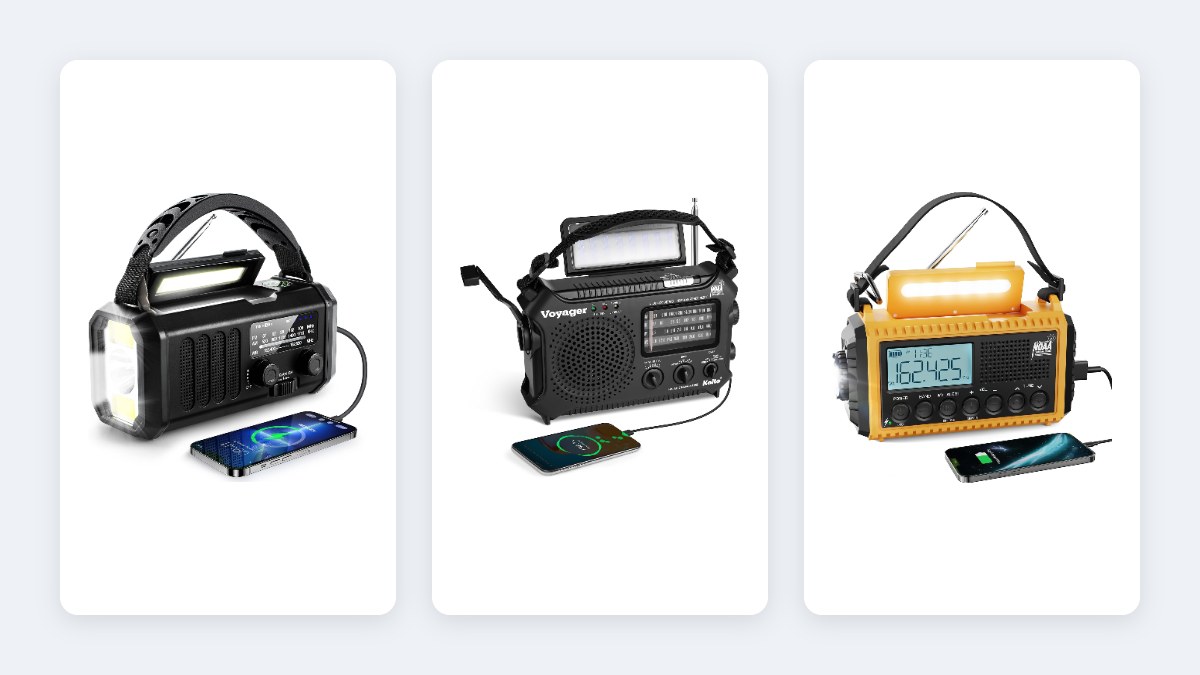
An emergency weather radio is one of the most useful things in a storm kit. It keeps you informed when power and cell networks go down, and many models double as a flashlight and phone charger. But the spec sheets all look similar, and the differences that matter in a real outage are easy to miss. Before you buy, check these eight things.
1. NOAA Weather Bands
Make sure the radio receives NOAA Weather Radio broadcasts. In the US these run on seven VHF frequencies between 162.400 and 162.550 MHz, usually labeled WX1 to WX7. The National Weather Service transmits forecasts, watches and warnings around the clock, and the network reaches the large majority of the US population. Canada’s Weatheradio service uses the same frequencies, so the same radio works there too.
That is the core reason to own one. An AM/FM-only radio depends on local stations staying on air and choosing to cover the storm. A weather band receiver goes straight to the source.
Tip: before buying, look up the NOAA transmitter nearest to you on the NWS website. If you live in a valley or far from a tower, a radio with a telescoping antenna will pull in a weak signal far better than one with only an internal antenna.
2. Automatic Alerts (and SAME)
This is the feature most people overlook. A basic weather radio only plays weather when you turn it on and tune in. An alert radio stays on standby, listens for the NWS 1050 Hz warning tone, and sounds an alarm automatically. That matters most overnight, when a tornado or flash flood warning can arrive while you are asleep.
There are two levels of alerting:
- Tone alert: the radio sounds for any warning on your channel. Simple, but a single transmitter can cover several counties, so you may get woken up for storms that are not near you.
- SAME alert: Specific Area Message Encoding lets you program your county code, so the radio only alarms for warnings that cover your area. If you want a radio that lives on a nightstand, SAME is worth paying for.
Many hand-crank survival radios have no alert function at all, so check the listing carefully. Look for the words “alert” or “SAME” rather than just “NOAA”.
3. Ways to Power It
Look for at least two off-grid options. The common ones are:
- Hand crank: always available, but slow. Expect to crank for a few minutes to get a short stretch of listening time. Treat it as a backup, not your main power source.
- Solar panel: the panels on handheld radios are small. They help keep the battery topped up over days of sun, but they will not recharge a large battery quickly.
- AA or AAA batteries: the most practical option for a multi-day outage, because you can swap in fresh cells in seconds. The Kaito KA500 is a good example of a radio that takes batteries alongside crank, solar, USB and AC power.
- USB charging: the easiest way to keep the built-in battery full between emergencies.
A radio with crank, solar and replaceable batteries covers almost every situation.
4. Battery and Phone Charging
Most emergency radios now include a built-in battery that can also charge a phone. A bigger battery (5,000–10,000mAh) can top up a typical smartphone one to three times. A smaller pack (around 2,000mAh) gives an emergency boost of maybe half a charge.
Two things to keep in mind. First, advertised capacity is measured at the cell, and some energy is lost in conversion, so real phone charges will be lower than the math suggests. Second, a bigger battery makes the radio heavier and slower to recharge by crank or solar. If phone charging is your main goal, a radio plus a separate power bank is often the better setup.
5. Extra Bands
AM/FM is standard. AM is especially useful in emergencies because AM signals travel farther, particularly at night, and many regions have designated emergency AM stations. Shortwave (SW) bands let you pick up broadcasts from much farther away. That is useful for hobby listening and in rare large-scale disasters, but most buyers will not need it.
6. Light and Signaling
A flashlight, reading lamp, SOS alarm or flashing beacon can be just as useful as the radio itself during an outage. A wide reading lamp is handier indoors than a narrow flashlight beam. An SOS siren or red strobe helps rescuers find you if you are trapped or stranded.
7. Durability and Water Resistance
Check the IP rating. IPX3 handles splashes and light rain. IPX4 handles splashing from any direction. IPX6 handles heavy rain and powerful jets of water. If the radio will live in a car, boat or camping bag, aim for IPX4 or better and make sure the USB ports have rubber covers.
8. Test It Before You Need It
Charge it, crank it and tune your local NOAA channel when you buy it. If it has SAME, program your county code and use the weekly NWS test (usually on Wednesdays) to confirm the alert sounds. Then recheck it at the start of each storm season.
Lithium batteries slowly lose charge in storage, so plug the radio in every few months. If you keep AA batteries in it, take them out for long-term storage, since leaking cells can ruin the contacts.
Common Mistakes to Avoid
- Buying a crank radio expecting automatic alerts. Most crank radios cannot alert you. If you want to be woken up, you need an alert or SAME model.
- Relying on the solar panel. It is a trickle charger. Keep the battery full from USB before storm season.
- Storing it somewhere you cannot reach in the dark. Keep it with a flashlight in a known spot, not at the back of a closet.
- Only owning one power option. If the built-in battery dies and there is no sun, crank or AA power is what keeps you informed.
Frequently Asked Questions
Do I need a weather radio if I have weather alerts on my phone?
Phone alerts are useful, but they depend on cell towers and a charged phone. Towers can go down or get overloaded in big storms. A weather radio receives the NWS broadcast directly, so it is a good backup.
Does a weather radio work outside the US?
NOAA weather bands work in the US and Canada. Elsewhere, the weather channels will be silent, but AM/FM and shortwave still work.
How long does hand cranking take?
It varies by model. As a rule of thumb, a few minutes of cranking gives you a short session of radio use. It is enough to catch a forecast update, not to listen all night.
Our Picks by Use Case
| Use Case | Our Pick | Price |
|---|---|---|
| Best overall | FosPower A1 | $79.99 |
| Tightest budget, biggest battery | Leaton 10000mAh | $47.99 |
| Most power options | Kaito KA500 | $49.99 |
| Automatic alerts | Raynic 5000mAh | $51.77 |
| Trusted radio brand | Midland ER310 | $79.99 |
| Bluetooth and everyday use | Midland ER310PRO | $99.99 |
For full comparisons and current prices, see our best emergency weather radios guide.
Related Guides
- Best Emergency Weather Radios for Every Budget in 2026
- FosPower A1 vs. Raynic Emergency Radio: Which Weather Radio Wins?
- FosPower A1 Emergency Weather Radio Review: Is It Worth $80 in 2026?
- 5 Best Alternatives to the FosPower A1 Emergency Radio in 2026
- What to Consider Before Buying an Emergency Weather Radio: A Complete Guide
Ugo Daniel researches, compares, and writes the buying guides on Wallstores, cross-checking manufacturer specs, verified pricing, and real customer feedback across tech, home, fitness, and pet categories. He’s personally bought and used many of the kitchen appliances featured on the site, and draws on that firsthand experience in those reviews.