
Disclosure: Wallstores is reader-supported. As an Amazon Associate, we earn from qualifying purchases made through links on this page, at no extra cost to you. Learn more.
How We Choose the Products We Recommend
We don’t have a warehouse full of gear to physically put through its paces — what we do instead is disciplined research. For every guide, we start with the manufacturer’s published specifications and compare them directly against competing models in the same price range. We track real, current pricing across retailers, not list prices that never actually apply, so the numbers in our comparisons reflect what you’d actually pay today. And we read, in bulk, through verified customer reviews and independent expert coverage for each product, looking for recurring complaints, common praise, and the patterns a single glossy product page won’t tell you.
Where we’ve personally bought and used a product ourselves — currently true for many of the kitchen items we cover — we say so directly in the review, and that firsthand experience shapes what we highlight. For everything else, our pros-and-cons calls come from that cross-referenced research process, not a single source or a rewritten spec sheet. We revisit guides periodically as prices shift and new models launch, and we link to multiple retailers where possible so you’re not stuck with just one option.

Ugo Daniel researches, compares, and writes the buying guides on Wallstores, cross-checking manufacturer specs, verified pricing, and real customer feedback across tech, home, fitness, and pet categories. He’s personally bought and used many of the kitchen appliances featured on the site, and draws on that firsthand experience in those reviews.
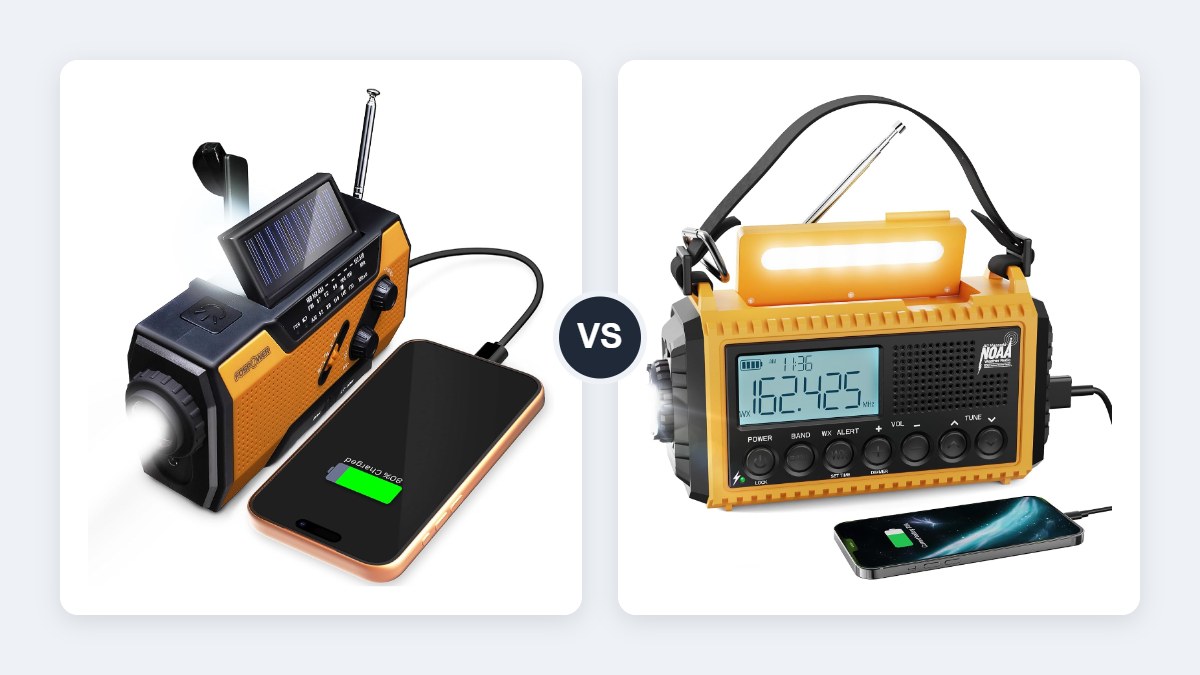
FosPower and Raynic make two of the best-selling emergency weather radios on Amazon. The FosPower A1 is the most-reviewed model, with a lifetime warranty. The Raynic costs less and adds automatic NOAA alerts, a big LCD and a larger battery. Here is which one belongs in your emergency kit.
FosPower A1 Emergency Weather Radio

Price: $79.99 · Rating: 4.6/5 (37,996 ratings)
Why we selected it: It is the most-reviewed emergency radio we track, at 4.6 stars from nearly 38,000 ratings, and it comes with a limited lifetime warranty.
Who it’s for: Households that want one dependable radio, light and phone charger in the emergency kit. Who should avoid it: buyers who want automatic alerts or shortwave.
Pros:
- Huge review base and 4.6-star average
- 2,000mAh (7,400mWh) power bank for phones
- Hand crank and solar charging
- 4-LED reading light and 1W flashlight
- Limited lifetime warranty
Cons:
- Smaller battery than the Leaton or Raynic
- No shortwave bands
Important specifications:
- NOAA weather + AM/FM
- 2,000mAh / 7,400mWh power bank
- 3 power sources including crank and solar
- Reading light and flashlight; limited lifetime warranty
Raynic 5000mAh Emergency Weather Radio

Price: $51.77 · Rating: 4.5/5 (20,813 ratings)
Why we selected it: It auto-scans for NOAA emergency alerts, has a large LCD with digital tuning and an SOS alarm, and has 20,800+ ratings at 4.5 stars.
Who it’s for: Anyone who wants to be woken by a severe-weather alert. Who should avoid it: buyers who need serious water resistance.
Pros:
- Automatic NOAA weather alert scanning
- Large LCD with digital tuning and battery level
- AM/FM/SW/NOAA bands
- 5,000mAh battery with multiple charging options
- 3W flashlight, SOS alarm, headphone jack
Cons:
- Only IPX3 splash resistance
- Smaller battery than the Leaton
Important specifications:
- 5,000mAh (18,500mWh) battery
- AM/FM/SW/NOAA, auto alert
- Large LCD, digital tuning
- IPX3, 1.2 lb, 6.8 x 3.7 x 2.9 in
Head-to-Head
| Feature | FosPower A1 | Raynic 5000mAh |
|---|---|---|
| Price | $79.99 | $51.77 |
| Rating | 4.6/5 (37,996) | 4.5/5 (20,813) |
| Bands | NOAA, AM/FM | NOAA, AM/FM, SW |
| Automatic NOAA alert | Not advertised | Yes |
| Battery / power bank | 2,000mAh (7,400mWh) | 5,000mAh (18,500mWh) |
| Light | 1W flashlight + reading light | 3W flashlight, SOS alarm |
| Warranty | Limited lifetime | See manufacturer |
Why Automatic Alerts Matter
A standard weather radio only plays forecasts when you turn it on and tune in. The Raynic can sit on standby, scan for NOAA alert broadcasts and sound an alarm when a warning is issued. That matters most for tornadoes and flash floods, which often hit overnight with little notice. If severe storms are a regular risk where you live, this feature alone may decide the matchup.
Keep in mind that a single NOAA transmitter can cover several counties, so a tone-alert radio may also wake you for warnings that do not affect your area. Radios with SAME county coding filter alerts more precisely, but they usually cost more.
Phone Charging in a Real Outage
The Raynic’s battery is more than twice the size of the FosPower’s power bank (18,500mWh vs. 7,400mWh). In practice, the FosPower can give a phone a useful emergency top-up, while the Raynic can provide most of a full charge for many phones, with some energy lost along the way. If you rely on your phone for alerts, maps or calls during outages, the bigger battery is a real advantage. A separate power bank in your kit is still a good idea with either radio.
Using Them in an Outage
- Keep the built-in battery charged from USB before storm season, so you are not relying on cranking.
- Use solar charging to top up during the day, but do not expect it to refill the battery quickly.
- Run the radio at low volume and use the light sparingly to stretch battery life.
- Tune to your local NOAA channel ahead of time so you know which one comes in best.
Who Should Buy Which?
| If you… | Choose |
|---|---|
| Live in tornado or flash-flood country | Raynic, for automatic alerts |
| Want the longest proven track record and a lifetime warranty | FosPower A1 |
| Need to charge phones for days | Raynic, or the Leaton for even more capacity |
| Want to listen to distant shortwave broadcasts | Raynic |
Frequently Asked Questions
Do these radios work outside the US?
The NOAA weather bands work in the US and Canada. AM and FM work anywhere, and the Raynic’s shortwave bands pick up broadcasts from much farther away.
Should I keep batteries in my emergency radio?
Keep the built-in battery charged and recheck it every few months. If a radio also takes disposable batteries, store them separately to avoid leaks.
How It Compares With Alternatives
The Leaton ($47.99) has an even bigger 10,000mAh battery and IPX6 water resistance for less. The Kaito KA500 ($49.99) can run on crank, solar, AA batteries, USB or AC power. The Midland ER310PRO ($99.99) adds Bluetooth music streaming.
Verdict: What Type of Buyer Should Choose Which
Pick the FosPower A1 if you want the most proven radio with a lifetime warranty. Pick the Raynic if you want automatic overnight alerts, a digital display and a bigger battery for about $28 less.
Related Guides
- Best Emergency Weather Radios for Every Budget in 2026
- FosPower A1 vs. Raynic Emergency Radio: Which Weather Radio Wins?
- FosPower A1 Emergency Weather Radio Review: Is It Worth $80 in 2026?
- 5 Best Alternatives to the FosPower A1 Emergency Radio in 2026
- What to Consider Before Buying an Emergency Weather Radio: A Complete Guide
Ugo Daniel researches, compares, and writes the buying guides on Wallstores, cross-checking manufacturer specs, verified pricing, and real customer feedback across tech, home, fitness, and pet categories. He’s personally bought and used many of the kitchen appliances featured on the site, and draws on that firsthand experience in those reviews.