
Disclosure: Wallstores is reader-supported. As an Amazon Associate, we earn from qualifying purchases made through links on this page, at no extra cost to you. Learn more.
How We Choose the Products We Recommend
We don’t have a warehouse full of gear to physically put through its paces — what we do instead is disciplined research. For every guide, we start with the manufacturer’s published specifications and compare them directly against competing models in the same price range. We track real, current pricing across retailers, not list prices that never actually apply, so the numbers in our comparisons reflect what you’d actually pay today. And we read, in bulk, through verified customer reviews and independent expert coverage for each product, looking for recurring complaints, common praise, and the patterns a single glossy product page won’t tell you.
Where we’ve personally bought and used a product ourselves — currently true for many of the kitchen items we cover — we say so directly in the review, and that firsthand experience shapes what we highlight. For everything else, our pros-and-cons calls come from that cross-referenced research process, not a single source or a rewritten spec sheet. We revisit guides periodically as prices shift and new models launch, and we link to multiple retailers where possible so you’re not stuck with just one option.

Ugo Daniel researches, compares, and writes the buying guides on Wallstores, cross-checking manufacturer specs, verified pricing, and real customer feedback across tech, home, fitness, and pet categories. He’s personally bought and used many of the kitchen appliances featured on the site, and draws on that firsthand experience in those reviews.
Last updated: November 2026 · Written by Ugo Daniel, founder of Wallstores
When the weather turns cold, the two most popular ways to stay warm without turning up the whole-house heat are a space heater and a heated blanket. Both plug into the wall, but their running costs are very different. This guide shows the real numbers, how to work out your own costs, and when each one makes sense.
The Short Answer
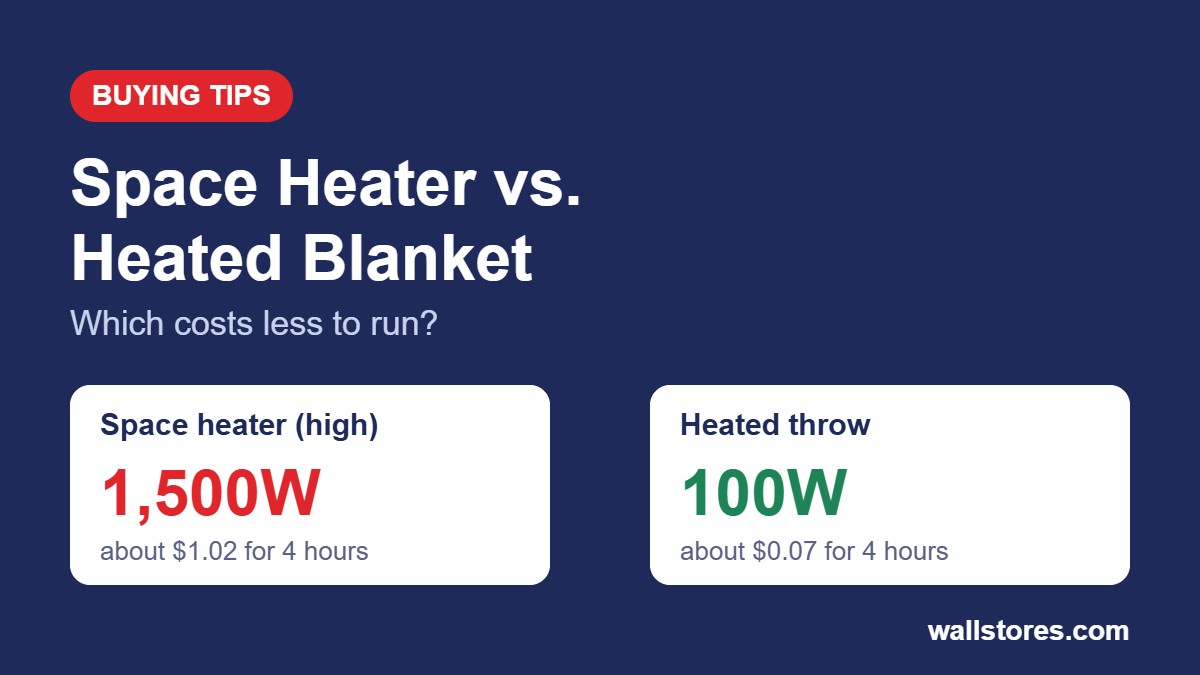
A heated blanket is far cheaper to run. A typical heated throw uses about 100 watts, while most plug-in space heaters use up to 1,500 watts on high. That means a space heater on full power can use around 15 times as much electricity as a heated throw in the same hour.
But they don’t do the same job. A blanket warms you. A space heater warms the room. The cheapest setup for most homes uses both in the right places.
How Much Power Each One Uses
| Device | Typical power use |
|---|---|
| Heated throw (one person, sofa) | About 100W |
| Heated bed blanket (queen or king) | About 100–200W, depending on size and setting |
| Heated mattress pad | Often similar to or below a bed blanket |
| Space heater on low | About 600–900W |
| Space heater on high | Up to 1,500W |
These are typical ranges. The exact figure for your device is printed on its label or listed in its manual.
How to Work Out the Cost
You only need three numbers: the device’s wattage, the hours you use it, and your electricity rate. The formula is:
Cost = (watts ÷ 1,000) × hours × price per kWh
Your price per kWh is on your electricity bill. The examples below use $0.17 per kWh, close to the recent US residential average. If you pay more or less, scale the numbers up or down.
Running Costs Side by Side
| Scenario | Energy used | Cost per day | Cost per month (30 days) |
|---|---|---|---|
| Heated throw, 100W, 4 hours an evening | 0.4 kWh | $0.07 | About $2 |
| Heated bed blanket, 150W average, 8 hours a night | 1.2 kWh | $0.20 | About $6 |
| Space heater cycling on its thermostat (about 750W average), 4 hours | 3 kWh | $0.51 | About $15 |
| Space heater on high, 1,500W, 4 hours | 6 kWh | $1.02 | About $31 |
| Space heater on high, 1,500W, 8 hours | 12 kWh | $2.04 | About $61 |
In real use, blankets usually cost even less than the table shows. Most people preheat the bed on a high setting, then switch to low or turn it off once they’re in. Space heaters with a thermostat also cycle off once the room reaches the set temperature, which is why the “cycling” row is more realistic than running flat-out on high.
Why Heating Yourself Is So Much Cheaper
A space heater has to warm all the air in a room, and that heat keeps escaping through windows, walls and drafts. A heated blanket puts a small amount of heat right next to your body, and the blanket itself holds it in. You’re heating one person instead of a whole room.
When a Heated Blanket Makes Sense
- You’re sitting still for long periods: watching TV, reading or working at a desk.
- You want a warm bed without heating the bedroom all night.
- You’re trying to keep the central thermostat a few degrees lower.
- You live alone or only need to warm one or two people.
When a Space Heater Makes Sense
- You’re moving around the room, so a blanket isn’t practical.
- Several people share the room.
- You need to take the chill off a cold room quickly, like a bathroom before a shower or a home office first thing in the morning.
- Someone in the home can’t safely use a heated blanket, such as young children.
The Cheapest Setup for Most Homes
- Lower the central thermostat a few degrees, especially overnight.
- Use a heated blanket or throw where people sit or sleep.
- Use a space heater only in the room you’re in, on a thermostat setting rather than high, and only while you’re there.
- Close doors to rooms you aren’t using, and block drafts under doors and around windows.
Safety Tips for Both
Space heaters: keep them at least three feet from anything that can burn, plug them directly into a wall outlet (not an extension cord or power strip), and never leave them running while you sleep or leave the room. Choose models with tip-over and overheat protection.
Heated blankets: lay them flat while they’re on, keep the controller uncovered, and don’t use them for infants or anyone who can’t feel heat or work the controls. Replace any blanket with damaged wiring or a controller that runs unusually hot.
Frequently Asked Questions
Is it cheaper to run a heated blanket all night than a space heater for an hour?
Usually, yes. A 150W blanket for 8 hours uses about 1.2 kWh. A 1,500W space heater on high uses 1.5 kWh in a single hour.
Does a space heater on “eco” mode save money?
It can. Eco and thermostat modes cut power once the room is warm, so the average draw is lower than running on high. The savings depend on how cold and drafty the room is.
Can I run a space heater and a heated blanket at the same time?
Yes, as long as they’re on different circuits or the circuit can handle the combined load. A 1,500W heater uses most of a standard 15-amp circuit on its own, so avoid adding other high-power appliances to the same circuit.
Choosing One
If you’re shopping, our guides explain what to look for in each:
- What to Consider Before Buying a Heated Blanket
- What to Consider Before Buying a Space Heater
- Winter Power Outage Checklist (for staying warm when the power goes out)
Ugo Daniel researches, compares, and writes the buying guides on Wallstores, cross-checking manufacturer specs, verified pricing, and real customer feedback across tech, home, fitness, and pet categories. He’s personally bought and used many of the kitchen appliances featured on the site, and draws on that firsthand experience in those reviews.