
How We Choose the Products We Recommend
We don’t have a warehouse full of gear to physically put through its paces — what we do instead is disciplined research. For every guide, we start with the manufacturer’s published specifications and compare them directly against competing models in the same price range. We track real, current pricing across retailers, not list prices that never actually apply, so the numbers in our comparisons reflect what you’d actually pay today. And we read, in bulk, through verified customer reviews and independent expert coverage for each product, looking for recurring complaints, common praise, and the patterns a single glossy product page won’t tell you.
Where we’ve personally bought and used a product ourselves — currently true for many of the kitchen items we cover — we say so directly in the review, and that firsthand experience shapes what we highlight. For everything else, our pros-and-cons calls come from that cross-referenced research process, not a single source or a rewritten spec sheet. We revisit guides periodically as prices shift and new models launch, and we link to multiple retailers where possible so you’re not stuck with just one option.

Ugo Daniel researches, compares, and writes the buying guides on Wallstores, cross-checking manufacturer specs, verified pricing, and real customer feedback across tech, home, fitness, and pet categories. He’s personally bought and used many of the kitchen appliances featured on the site, and draws on that firsthand experience in those reviews.
Last updated: September 2026
When counter space is limited, a rice cooker has to earn its spot — it can’t just cook rice well, it has to actually fit. We compared five rice cookers that stay small without cutting the features that make a rice cooker worth owning in the first place: consistent results, a real keep-warm function, and a footprint that won’t take over a small kitchen. Whether you’re cooking for one or feeding a small household, there’s a size and price point below that fits.
Quick Comparison
| Product | Best For | Capacity (Cooked) | Footprint | |
|---|---|---|---|---|
| Aroma Housewares ARC-914SBD | Best Overall | 8 cups | 8.6″ x 9.25″ x 8.5″ | See Price on Amazon → |
| Zojirushi NL-BAC05SB Micom | Best Premium / Smallest Footprint | 6 cups | Compact (triple heater design) | See Price on Amazon → |
| Dash Mini Rice Cooker (DRCM200BK) | Best Budget / Single-Serve | 2 cups | Compact, 2.2 lbs | See Price on Amazon → |
| Cosori Rice Cooker 10 Cup (CRC-R501) | Best for Small Households | 10 cups | 12.3″ x 10.6″ x 9.2″ | See Price on Amazon → |
| Toshiba Mini Rice Cooker (3-Cup) | Best Mid-Size Alternative | 6 cups | 9″ x 11″ x 8″ | See Price on Amazon → |
1. Aroma Housewares ARC-914SBD Digital Rice Cooker — Best Overall
 This is the pick that shows up again and again in independent testing, and the reason is balance: it holds a genuinely useful 8 cups cooked (4 cups uncooked) while still keeping a footprint under 9 inches square, and its “Sensor Logic” adjusts cook time automatically based on what’s actually in the pot rather than a fixed timer. A 15-hour delay timer means you can load it in the morning and come home to hot rice. On Amazon, it holds a 4.5-star average across more than 65,000 reviews.
Pros: strong capacity-to-footprint ratio, auto-adjusting Sensor Logic, long delay timer, stainless steel exterior.
Cons: digital controls have a learning curve compared to a simple one-switch cooker, and it’s a basic rice/steam cooker rather than a multi-function appliance.
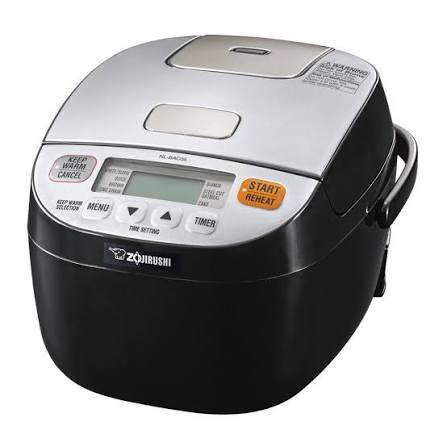
2. Zojirushi NL-BAC05SB Micom Rice Cooker — Best Premium / Smallest Footprint
 Zojirushi is thename most serious home cooks reach for, and this Micom model is built around a triple-heater design (bottom, side, and top) that cooks more evenly than a single-element budget cooker — the difference shows up most in how long rice stays good on the keep-warm setting without drying out or yellowing. It’s the smallest true footprint on this list relative to its 6-cup cooked capacity. On Amazon, it holds a 4.7-star average from nearly 2,000 reviews.
Pros: excellent even-heat cooking, keeps rice warm and fresh for hours, compact for its capacity, well-regarded build quality.
Cons: the highest price on this list by a wide margin, and it’s a rice specialist rather than a do-everything appliance.
3. Dash Mini Rice Cooker (DRCM200BK) — Best Budget / Single-Serve
 At 2.2 lbs and sized for 2 cups cooked, this is the pick for a dorm room, a small apartment kitchen, or anyone who mostly cooks rice for one. The nonstick pot is fully removable for easy cleanup, and beyond rice it handles oatmeal, quinoa, and other grains reasonably well, which stretches its usefulness past just rice night. On Amazon, it holds a 4.4-star average across nearly 48,000 reviews.
Pros: lowest price on this list, smallest and lightest option, removable nonstick pot, doubles for other grains.
Cons: capacity is genuinely limited to 1-2 people, and it lacks the fuzzy-logic sensing of the pricier picks.
4. Cosori Rice Cooker 10 Cup (CRC-R501) — Best for Small Households
 If “small kitchen” describes your counter space but not your household size, the Cosori bridges that gap — it holds 10 cups cooked, enough for a family of four with leftovers, while its 18-in-1 functions (steam, sauté, slow cook, and more) mean it can replace a couple of other single-purpose gadgets you might otherwise need counter space for. The ceramic-coated inner pot is dishwasher safe, which matters more day to day than it sounds. On Amazon, it holds a 4.8-star average from nearly 6,000 reviews.
Pros: largest capacity here, genuinely multi-functional (not just rice), dishwasher-safe parts, 24-hour keep warm.
Cons: the largest footprint on this list, so it’s the one pick here that trades some counter space for capacity and features.
5. Toshiba Mini Rice Cooker (3-Cup) — Best Mid-Size Alternative
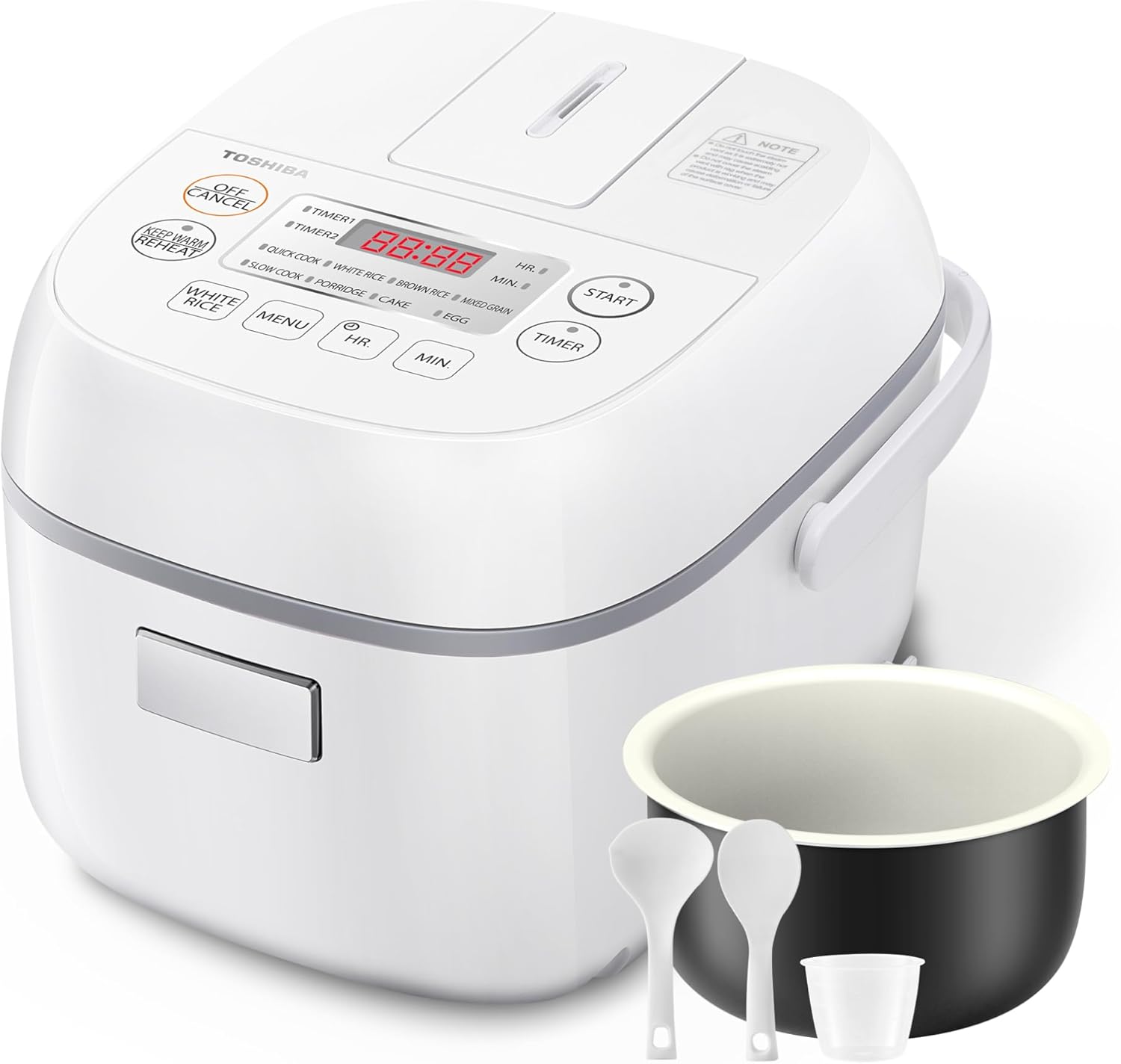 Sitting between the Dash Mini and the Aroma in both capacity and price, this Toshiba model uses fuzzy-logic cooking and one-touch operation with a 24-hour delay timer — features usually reserved for larger, pricier cookers, scaled down to a 6-cup cooked capacity that suits 1-3 people well.
Pros: fuzzy logic at a mid-range price, one-touch cooking, long delay timer, nonstick inner pot.
Cons: mid-pack capacity means it’s not the best fit for either a single person (where the Dash is cheaper) or a bigger household (where the Cosori makes more sense).
How to Choose a Rice Cooker for a Small Kitchen
Capacity: a rough rule of thumb is about 1 cup of uncooked rice per 2 people per meal, so a 3-cup uncooked cooker comfortably serves a household of four to six with leftovers — buy for your household size, not just your counter space. Footprint vs. capacity: the two aren’t always linked the way you’d expect — as this list shows, some 6-cup cookers are more compact than others, so check actual dimensions rather than assuming smaller capacity always means a smaller appliance. Fuzzy logic: this just means the cooker senses moisture and temperature and adjusts cook time automatically, rather than running a fixed timer — it’s the difference between “usually good rice” and “consistently good rice” across different rice types. Keep-warm function: check how many hours it’s rated for and whether reviewers say rice actually stays appealing that whole time, since this varies more between models than the spec sheet suggests. Cleanup: a removable, dishwasher-safe inner pot matters far more in daily use than any other single feature.
FAQ
How many cups of rice cooked equals how many servings? As a general guide, 1 cup of cooked rice is roughly one generous serving, so an 8-cup cooker can serve a family meal with leftovers.
What does “fuzzy logic” actually mean? It’s a type of onboard sensing that adjusts cooking time and temperature based on the rice and water actually in the pot, rather than a single fixed program — it generally produces more consistent results across different rice types.
Can a mini rice cooker do more than cook rice? Most can handle basic steaming (vegetables, dumplings) and simple grains like quinoa or oatmeal; multi-function models like the Cosori add sauté and slow-cook modes on top of that.
Do rice cookers need a special outlet or a lot of power? No — every model on this list runs on a standard household outlet, same as a coffee maker or toaster.
How do I clean a rice cooker? Look for a fully removable inner pot; nonstick and ceramic-coated pots wipe clean easily by hand, and several models on this list have dishwasher-safe parts.
Affiliate disclosure: As an Amazon Associate, WallStores earns from qualifying purchases. Prices and availability shown on Amazon at the time of your visit — click through for current pricing.
Related Guides
Ugo Daniel researches, compares, and writes the buying guides on Wallstores, cross-checking manufacturer specs, verified pricing, and real customer feedback across tech, home, fitness, and pet categories. He’s personally bought and used many of the kitchen appliances featured on the site, and draws on that firsthand experience in those reviews.