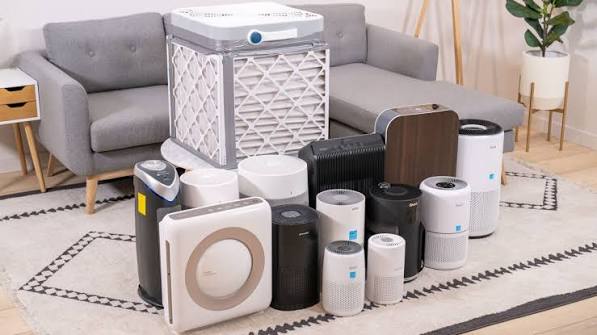
Allergy season doesn’t wait for a five-star Amazon listing to be accurate, so we focused on purifiers with independently verifiable HEPA performance, not just marketing claims. Each pick below covers a different room size and budget, and every model uses true HEPA or HEPA-equivalent filtration rated to capture the pollen, dander, and dust that actually trigger allergy symptoms. We also flag the one real compromise on each unit, because no air purifier gets everything right.
Quick Comparison
| Purifier | Best For | CADR | Coverage | |
|---|---|---|---|---|
| Levoit Core 300S-P | Best Budget Pick | 141 CFM | 219 sq ft (allergy-grade) | See Price on Amazon → |
| Coway Airmega 200M | Best for Medium Rooms | 246-277 CADR | 361 sq ft | See Price on Amazon → |
| Honeywell InSight HPA5300B | Best for Large Rooms | 99.97% HEPA capture | 500 sq ft (allergy-grade) | See Price on Amazon → |
| Winix 5510 | Best App-Connected Value | 247-253 CADR | 392 sq ft | See Price on Amazon → |
| Blueair Blue Pure 211+ | Best Airflow | ~350 CFM | 540 sq ft | See Price on Amazon → |
1. Levoit Core 300S-P Smart Air Purifier — Best Budget Pick
 The Core 300S-P is the purifier we point budget-conscious allergy sufferers to first. It’s a compact cylinder built around a real 3-in-1 HEPA filter that traps pollen and pet dander down to 0.3 microns, and Levoit’s app lets you track particle counts and automate fan speed instead of guessing. At 141 CFM CADR it’s rated for a 219-square-foot room at true allergy-grade air-change speed, so treat the larger number on the box as a background-freshening claim, not an allergy claim. The tradeoff: that filter is a sealed 3-in-1 unit, not separately washable layers, so replacement cost creeps up over a year of heavy allergy-season use.
Pros: app-controlled auto mode, quiet down to 22dB, affordable filter subscription.
Cons: sealed non-washable filter, real allergy coverage smaller than marketed sq ft.
2. Coway Airmega 200M — Best for Medium Rooms
 Coway built its reputation on quiet, capable mid-size purifiers, and the Airmega 200M keeps that streak going. Its four-stage system pairs a washable pre-filter and deodorization layer with a true HEPA filter and a light-based air quality indicator that actually changes color when pollen or cooking smoke spikes. CADR numbers in the 246–277 range across smoke, dust, and pollen are strong for its class, and it stays impressively quiet even at higher fan speeds. The tradeoff is price: at around $230 for 361 square feet of coverage, you’re paying a premium versus similarly-specced competitors.
Pros: real-time air quality indicator, very quiet operation, strong CADR for its size.
Cons: premium price for coverage area, filter replacements add up.
3. Honeywell InSight HPA5300B — Best for Large Rooms
 Honeywell’s Allergen Plus line has been a staple in allergist-recommended lists for years, and the current InSight HPA5300B carries that forward with true HEPA filtration rated to capture 99.97% of allergens down to microscopic dust mite debris. It’s built for genuinely large rooms, rated to 500 square feet at true allergy-grade air changes and up to 2,423 square feet for basic circulation, with a built-in air quality monitor and auto mode that ramps up during pollen spikes. The tradeoff is that it’s a big, utilitarian console with no WiFi or app control, and it’s on the louder side at its top Turbo setting.
Pros: rated for extra-large rooms, built-in air quality sensor, 99.97% HEPA capture.
Cons: no WiFi/app control, loud at top Turbo speed.
4. Winix 5510 — Best Smart/App-Connected Value
 The Winix 5510 is the direct successor to the long-loved 5500-2, upgrading the formula with WiFi and app control while keeping the same 4-stage core: a washable pre-filter, AOC carbon layer for odors, true HEPA, and Winix’s PlasmaWave ionizer. CADR scores in the low-250s across dust, pollen, and smoke back up its AHAM-verified 392-square-foot rating. The tradeoff: PlasmaWave is an ionizing technology, and a subset of sensitive users report a faint odor when it’s left on, though it can be switched off entirely.
Pros: WiFi/app control added over predecessor, strong balanced CADR scores, washable carbon pre-filter.
Cons: PlasmaWave ionizer can be polarizing, pricier than the discontinued 5500-2 was.
5.— Best Airflow / Best Design
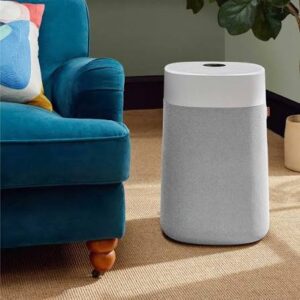 The Blue Pure 211+ has stuck around for a reason: it’s a genuinely simple, high-airflow purifier built around Blueair’s HEPASilent technology, which combines mechanical filtration with an electrostatic charge to push more air through the filter without needing a loud motor. CADR is rated around 350 CFM across smoke, dust, and pollen, with coverage up to 540 square feet, making it one of the strongest airflow-per-dollar picks for a larger bedroom or living room. It also has a fabric pre-filter you can swap for a pop of color. The tradeoff is that it’s dial-only, three fixed speeds and no auto mode or air quality sensor.
Pros: highest CADR-per-dollar of the group, swappable fabric pre-filter colors, energy-efficient HEPASilent design.
Cons: no auto mode or air quality sensor, dial-only 3-speed control.