
How We Choose the Products We Recommend
We don’t have a warehouse full of gear to physically put through its paces — what we do instead is disciplined research. For every guide, we start with the manufacturer’s published specifications and compare them directly against competing models in the same price range. We track real, current pricing across retailers, not list prices that never actually apply, so the numbers in our comparisons reflect what you’d actually pay today. And we read, in bulk, through verified customer reviews and independent expert coverage for each product, looking for recurring complaints, common praise, and the patterns a single glossy product page won’t tell you.
Where we’ve personally bought and used a product ourselves — currently true for many of the kitchen items we cover — we say so directly in the review, and that firsthand experience shapes what we highlight. For everything else, our pros-and-cons calls come from that cross-referenced research process, not a single source or a rewritten spec sheet. We revisit guides periodically as prices shift and new models launch, and we link to multiple retailers where possible so you’re not stuck with just one option.

Ugo Daniel researches, compares, and writes the buying guides on Wallstores, cross-checking manufacturer specs, verified pricing, and real customer feedback across tech, home, fitness, and pet categories. He’s personally bought and used many of the kitchen appliances featured on the site, and draws on that firsthand experience in those reviews.
Last updated: September 2026
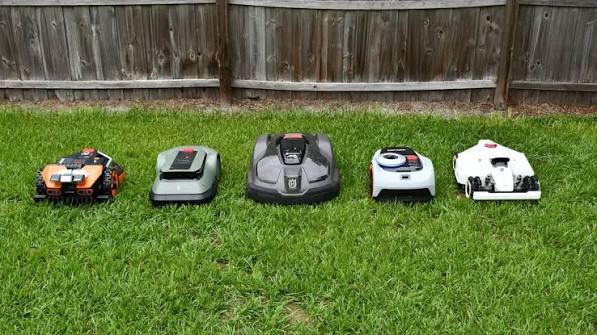
Robot lawn mowers have finally caught up to the hype: 2026’s best models trade buried perimeter wire for RTK GPS, LiDAR, and AI camera navigation, so setup can take an afternoon instead of a weekend. Whether you’re after a budget-friendly starter bot for a small backyard or an all-wheel-drive machine that can chew through a steep, sprawling lawn, there’s now a genuinely good option at nearly every price point. We compared five of the most current, in-stock robot mowers on the market to help you pick the right one for your yard.
Quick Comparison
| Product | Best For | Coverage | Price | |
|---|---|---|---|---|
| Segway Navimow i110N | Best Overall | 0.25 Acre | $669–$1,099 | See Price on Amazon → |
| ECOVACS Goat O1000 RTK Care | Best Budget | 0.25 Acre | $664.00 | See Price on Amazon → |
| Worx Landroid Vision Cloud WR320 | Best for Small Yards | 0.5 Acre | $1,099–$1,799 | See Price on Amazon → |
| Mammotion LUBA 3 AWD 3000H | Best for Large/Hilly Yards | 0.75 Acre | $2,499–$2,799 | See Price on Amazon → |
| Sunseeker S4 | Best No-Perimeter-Wire | 0.25 Acre | $999.98 | See Price on Amazon → |
1. Segway Navimow i110N Robot Lawn Mower — Best Overall
 Segway’s Navimow i110N is the clearest example of how far wire-free robot mowing has come — it maps your quarter-acre yard using RTK positioning plus a camera-based VisionFence system, so there’s no trenching or boundary wire to bury. At a real-world price well under many of its wire-free rivals, it’s quiet enough (58 dB) to run without annoying neighbors, and the app makes multi-zone setup and scheduling straightforward. On Amazon, it holds a 4.0-star average across more than 500 ratings.
Pros: no perimeter wire needed — RTK + camera vision handles boundary mapping, very quiet 58 dB(A) operation, AI obstacle avoidance recognizes 150+ object types, strong value versus other wire-free competitors when on sale.
Cons: coverage capped at about 0.25 acre — not for bigger yards, modest 30% max slope rating limits use on hilly terrain.
2. ECOVACS Goat O1000 RTK Care Robot Lawn Mower — Best Budget
 The Goat O1000 RTK Care is ECOVACS’s budget entry into wire-free robotic mowing, using RTK satellite positioning for centimeter-level accuracy instead of a buried boundary wire or a pricier LiDAR setup. It follows systematic mowing paths rather than random bouncing for more even coverage, ships with an RTK extension cable for better signal in tricky yards, and the CARE bundle throws in 36 extra blades to keep cutting performance sharp for seasons to come. It carries a 3.9-star average across 152 Amazon ratings.
Pros: one of the most affordable wire-free mowers available, no perimeter wire to bury thanks to RTK satellite positioning, systematic (not random) mowing paths for more even coverage, includes 36 replacement blades for years of upkeep.
Cons: smaller 1/4-acre coverage than pricier RTK/LiDAR mowers on this list, fewer long-term reliability reports than Husqvarna’s decades-old Automower line, RTK signal quality can suffer in yards with heavy tree cover.
3. Worx Landroid Vision Cloud WR320 — Best for Small Yards
 Worx’s Landroid Vision Cloud line replaces the brand’s older wire-free mowers with a sharper RTK-plus-camera navigation stack, and the half-acre WR320 is the sweet spot for smaller, more complex suburban lawns. Its built-in cut-to-edge trimmer is a genuinely useful touch, shaving grass right up against beds and fences that most robot mowers leave untouched. It’s a newer listing still building review volume, holding a 3.8-star average across 59 Amazon ratings so far.
Pros: no boundary wire — uses RTK GPS + VSLAM AI vision mapping, built-in cut-to-edge trimmer reduces manual edging, app-guided setup and multi-zone scheduling, frequently discounted several hundred dollars off list.
Cons: 30% max slope rating isn’t suited to sloped yards, list price is steep before discounts are applied, newer platform with a shorter public reliability track record.
4. Mammotion LUBA 3 AWD 3000H Robot Lawn Mower — Best for Large/Hilly Yards
 Mammotion built its reputation on all-wheel-drive mowers that shrug off slopes other robot mowers can’t handle, and the 2026 LUBA 3 AWD continues that with a claimed 80% slope rating and a new Tri-Fusion navigation system that fuses 360° LiDAR, RTK, and AI camera vision — no fixed RTK base antenna required. It’s a genuinely large, heavy machine built for demanding terrain, and it supports up to 30 mapped zones for complex, multi-section properties. It’s still early on Amazon, with a 4.0-star average across 38 ratings so far.
Pros: all-wheel drive rated for up to 80% slopes — best-in-class hill handling, Tri-Fusion LiDAR + RTK + AI vision navigation, no wire or fixed antenna needed, supports up to 30 multi-zone mapped areas for complex properties, current-generation 2026 flagship with active manufacturer support.
Cons: premium price (~$2,500+) puts it out of reach for casual buyers, heavy unit (over 40 lbs), harder to lift or move manually, newer platform — the previous LUBA 2 AWD line was phased out within about a year.
5. Sunseeker S4 Robot Lawn Mower — Best No-Perimeter-Wire
 Sunseeker built the S4 specifically for tricky, wire-free yards — dense trees, shade, eaves, and narrow passages — using 360° 3D LiDAR combined with Vision AI to map and navigate without ever needing a buried boundary wire or base-station calibration. Its 10-TOPS AllSense system plans systematic parallel routes even in low light or weak-GPS-signal areas, and rear-wheel drive handles bumps, ruts, and passages as narrow as 31.5 inches. It’s backed by a 2-year warranty and U.S.-based support. It’s a newer listing with a thin but promising 4.4-star average across 29 Amazon ratings so far.
Pros: no perimeter wire — 3D LiDAR + Vision AI mapping works without base-station calibration, handles complex yards with dense trees, shade, and narrow passages down to 31.5 inches, systematic parallel mowing routes even in low light or weak-signal spots, 2-year warranty with U.S.-based support.
Cons: smaller 0.25-acre coverage than AWD rivals like the Mammotion LUBA line, slope rating (22°/42%) trails steeper-capable competitors, fewer long-term reliability reports than Husqvarna or Worx.
Related Guides
Ugo Daniel researches, compares, and writes the buying guides on Wallstores, cross-checking manufacturer specs, verified pricing, and real customer feedback across tech, home, fitness, and pet categories. He’s personally bought and used many of the kitchen appliances featured on the site, and draws on that firsthand experience in those reviews.