
How We Choose the Products We Recommend
We don’t have a warehouse full of gear to physically put through its paces — what we do instead is disciplined research. For every guide, we start with the manufacturer’s published specifications and compare them directly against competing models in the same price range. We track real, current pricing across retailers, not list prices that never actually apply, so the numbers in our comparisons reflect what you’d actually pay today. And we read, in bulk, through verified customer reviews and independent expert coverage for each product, looking for recurring complaints, common praise, and the patterns a single glossy product page won’t tell you.
Where we’ve personally bought and used a product ourselves — currently true for many of the kitchen items we cover — we say so directly in the review, and that firsthand experience shapes what we highlight. For everything else, our pros-and-cons calls come from that cross-referenced research process, not a single source or a rewritten spec sheet. We revisit guides periodically as prices shift and new models launch, and we link to multiple retailers where possible so you’re not stuck with just one option.

Ugo Daniel researches, compares, and writes the buying guides on Wallstores, cross-checking manufacturer specs, verified pricing, and real customer feedback across tech, home, fitness, and pet categories. He’s personally bought and used many of the kitchen appliances featured on the site, and draws on that firsthand experience in those reviews.
Last updated: September 2026
A smart thermostat is still one of the fastest-payback upgrades you can make to a home in 2026 — better zone comfort, fewer wasted heating and cooling cycles, and the convenience of adjusting the temperature from your phone or a voice assistant. But with Google, Ecobee, Amazon, Honeywell, and Copeland (formerly Emerson) all fielding strong, frequently-updated models, picking the right one depends heavily on which smart home ecosystem you’re already in and how much you want to spend. Below we compare five current, in-stock picks — from a $60 budget option to a premium sensor-packed flagship — to help you choose the best fit for your home.
Quick Comparison
| Product | Best For | Price | |
|---|---|---|---|
| Google Nest Learning Thermostat (4th Gen) | Best Overall | $236.00 | See Price on Amazon → |
| ecobee Smart Thermostat Premium | Best for Apple HomeKit & Air Quality | $259.99 | See Price on Amazon → |
| Amazon Smart Thermostat | Best Budget Pick | $79.99 | See Price on Amazon → |
| Honeywell Home X8S + Room Sensor | Best for Multi-Room Comfort | $259.99 | See Price on Amazon → |
| Sensi Touch 2 (ST76) | Best Value Upgrade Pick | $159.99 | See Price on Amazon → |
1. Google Nest Learning Thermostat (4th Gen) + Nest Temperature Sensor — Best Overall
 The 4th-gen Nest Learning Thermostat keeps what made the original great — a genuinely useful learning algorithm that builds your schedule automatically — while adding a 60% larger, easier-to-read display and Matter certification for broader smart home compatibility. Adaptive Eco and the included remote temperature sensor mean it actually adjusts to how your home behaves, and Google claims combined heating/cooling savings of up to 31%. It’s the safest all-around pick for most households, especially anyone already using Google Home or Android devices. On Amazon, it holds a 4.4-star average across more than 2,500 ratings.
Pros: learns your schedule automatically, no manual programming, larger, brighter display than previous generations, included remote sensor improves whole-home accuracy, Matter-certified for broad smart home hub compatibility.
Cons: pricier than most competitors, especially the sensor bundle, deepest features lean toward Google Home over Alexa/HomeKit, compatible with ~85% of 24V systems, not universal.
2. ecobee Smart Thermostat Premium — Best for Apple HomeKit & Air Quality
 The ecobee Premium stands apart with built-in Siri and Alexa voice control plus an indoor air quality monitor that tracks VOCs, humidity, and particulates — something neither the Nest nor the budget picks offer. It ships with one SmartSensor for room-by-room occupancy and temperature balancing, and it’s one of the few thermostats with genuinely deep, native Apple Home integration alongside Alexa, Google Assistant, and SmartThings. If air quality tracking or an Apple-centric smart home matters to you, this is the pick. It carries a 4.3-star average across more than 4,100 Amazon ratings.
Pros: built-in air quality monitoring (VOCs, humidity) not found on rivals, native Siri and Alexa voice control built into the unit, broad ecosystem support: Apple Home, Alexa, Google Assistant, SmartThings, included SmartSensor improves multi-room accuracy out of the box.
Cons: among the pricier options here, even on sale, larger physical footprint than the Nest or budget picks, mobile app has an occasional learning curve for scheduling.
3. Amazon Smart Thermostat (TSTATJ-01) — Best Budget Pick
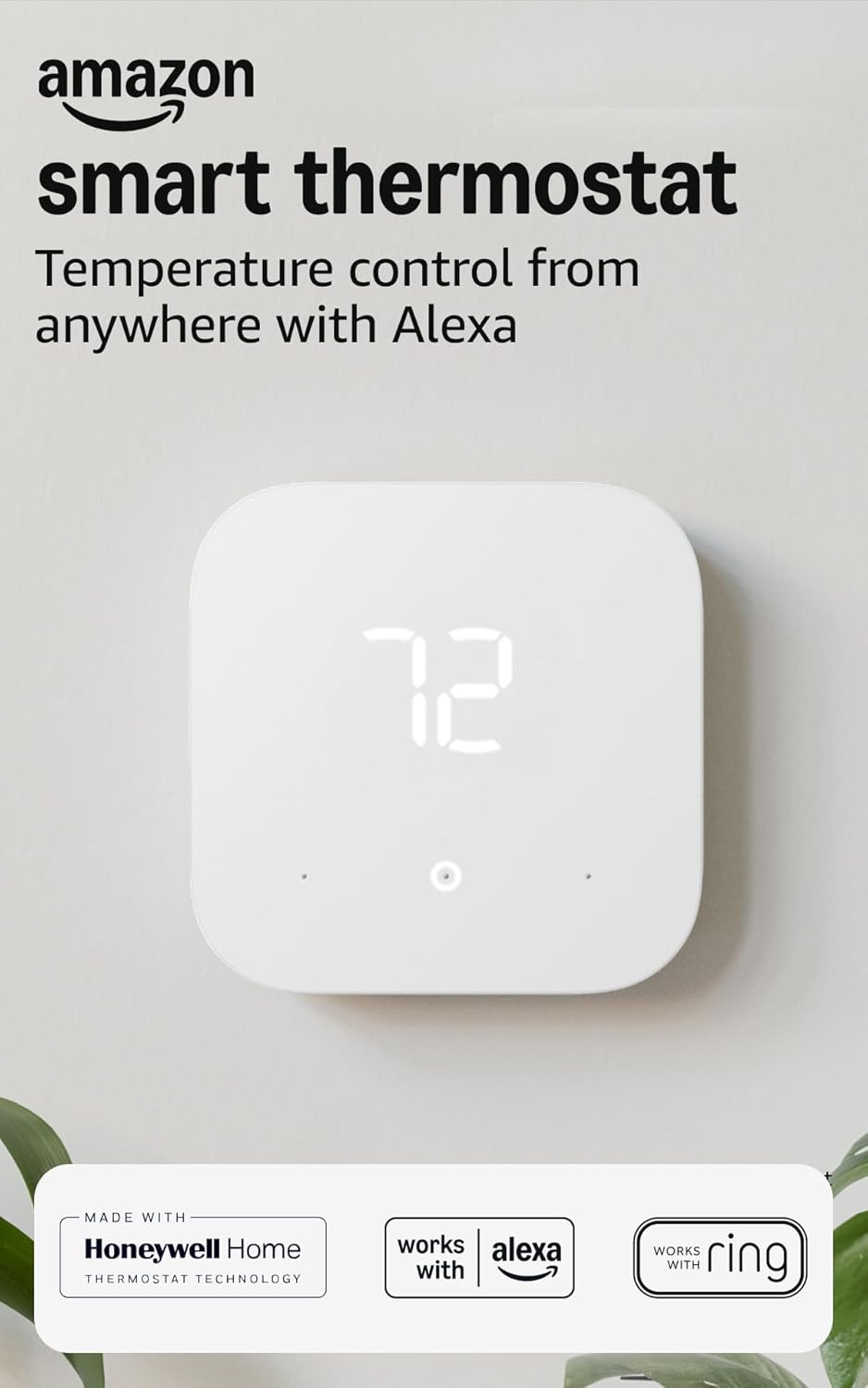 At around $60–$80, the Amazon Smart Thermostat undercuts nearly every rival on this list while still delivering ENERGY STAR certification, app-guided DIY installation, and tight Alexa/Ring integration. Reviewers consistently praise its setup experience — push-in wire connectors and step-by-step in-app video guidance make it one of the easiest thermostats to self-install. The tradeoff is a simpler feature set and an ecosystem locked almost entirely to Alexa, but for anyone who just wants reliable scheduling and voice control on a budget, it delivers. It’s also one of Amazon’s best-selling thermostats outright, with a 4.0-star average across more than 25,000 ratings.
Pros: lowest price of any model in this roundup, especially on sale, excellent, beginner-friendly DIY installation with in-app guidance, tight Alexa and Ring integration for existing Amazon households, ENERGY STAR certified with EPA-estimated ~$50/year savings.
Cons: requires a C-wire or separate power adapter kit (sold separately), Alexa-only ecosystem — no native HomeKit or deep Google Home support, companion app is reported as occasionally slow or laggy.
4. Honeywell Home X8S Smart Thermostat with Room Sensor — Best for Multi-Room Comfort
 The Honeywell Home X8S differentiates itself with a wireless room sensor built into the box — rated for up to 200 feet of range, it can balance temperature readings across a home instead of relying on a single hallway thermostat reading. It supports Matter, Alexa, Google Assistant, and Apple Home, giving it arguably the widest smart-home compatibility of any model here, and it adds humidity/air-quality control plus doorbell camera view and intercom support (with a compatible Ring or First Alert doorbell) that none of the other picks offer. Reviewers consistently call out the responsive room sensor as its standout feature. It holds a 4.1-star average across 145 Amazon ratings.
Pros: Matter-certified with the widest smart-home support here: Alexa, Google Assistant, and Apple Home, wireless room sensor included for balanced multi-room comfort (200 ft range), humidity/air-quality control plus doorbell camera view and intercom support, ENERGY STAR certified with rebate-program eligibility.
Cons: companion app is less polished than Nest or Ecobee’s apps, C-wire typically required (Honeywell mails a free adapter voucher if you don’t have one), doesn’t work with electric baseboard heat.
5. Sensi Touch 2 Smart Thermostat (ST76) by Copeland — Best Value Upgrade Pick
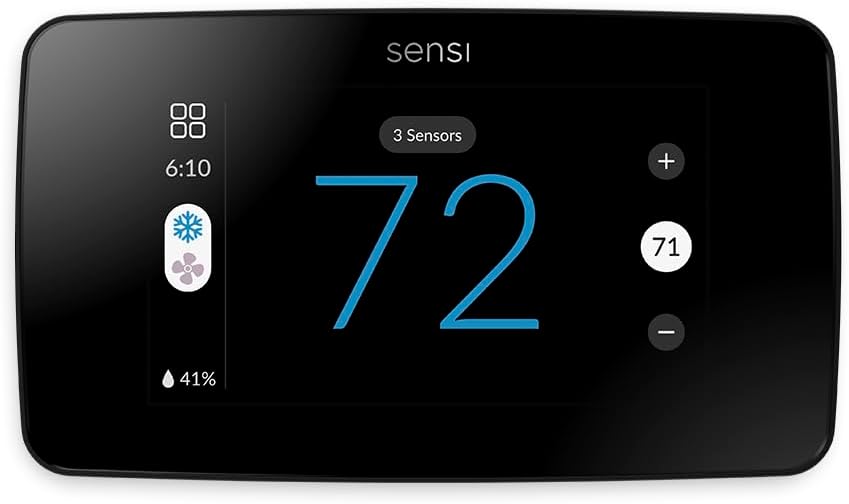 The Sensi Touch 2 offers a genuinely nice color touchscreen and ENERGY STAR-certified efficiency (up to 23% claimed HVAC savings) at a price that undercuts both the Nest and Ecobee flagships. Copeland’s long HVAC pedigree shows in build quality and broad system compatibility, and the brand has built a reputation on straightforward, well-documented DIY installation. Note: this thermostat was previously sold under the Emerson brand and is now sold under Copeland — same product, updated branding. It carries a 4.3-star average across more than 1,200 Amazon ratings.
Pros: color touchscreen display at a mid-range price point, ENERGY STAR certified, up to 23% claimed energy savings, strong data-privacy stance — Copeland states it doesn’t sell user data, well-documented, step-by-step DIY installation.
Cons: requires a C-wire (unlike some other Sensi/Copeland models), brand transition from Emerson to Copeland creates some listing confusion, smart home ecosystem support is narrower than the Honeywell X8S’s.
Related Guides
Ugo Daniel researches, compares, and writes the buying guides on Wallstores, cross-checking manufacturer specs, verified pricing, and real customer feedback across tech, home, fitness, and pet categories. He’s personally bought and used many of the kitchen appliances featured on the site, and draws on that firsthand experience in those reviews.