
Disclosure: Wallstores is reader-supported. As an Amazon Associate, we earn from qualifying purchases made through links on this page, at no extra cost to you. Learn more.
How We Choose the Products We Recommend
We don’t have a warehouse full of gear to physically put through its paces — what we do instead is disciplined research. For every guide, we start with the manufacturer’s published specifications and compare them directly against competing models in the same price range. We track real, current pricing across retailers, not list prices that never actually apply, so the numbers in our comparisons reflect what you’d actually pay today. And we read, in bulk, through verified customer reviews and independent expert coverage for each product, looking for recurring complaints, common praise, and the patterns a single glossy product page won’t tell you.
Where we’ve personally bought and used a product ourselves — currently true for many of the kitchen items we cover — we say so directly in the review, and that firsthand experience shapes what we highlight. For everything else, our pros-and-cons calls come from that cross-referenced research process, not a single source or a rewritten spec sheet. We revisit guides periodically as prices shift and new models launch, and we link to multiple retailers where possible so you’re not stuck with just one option.

Ugo Daniel researches, compares, and writes the buying guides on Wallstores, cross-checking manufacturer specs, verified pricing, and real customer feedback across tech, home, fitness, and pet categories. He’s personally bought and used many of the kitchen appliances featured on the site, and draws on that firsthand experience in those reviews.
Last updated: October 2026 · Written by Ugo Daniel, founder of Wallstores
Portable power station specs range from 256Wh backpack units to 2000Wh+ home-backup systems, and the numbers that matter most aren’t always the ones brands lead with. Here’s what to actually check, based on comparing six current, real Amazon listings.


Capacity (Wh) vs. Output (W) — They Measure Different Things
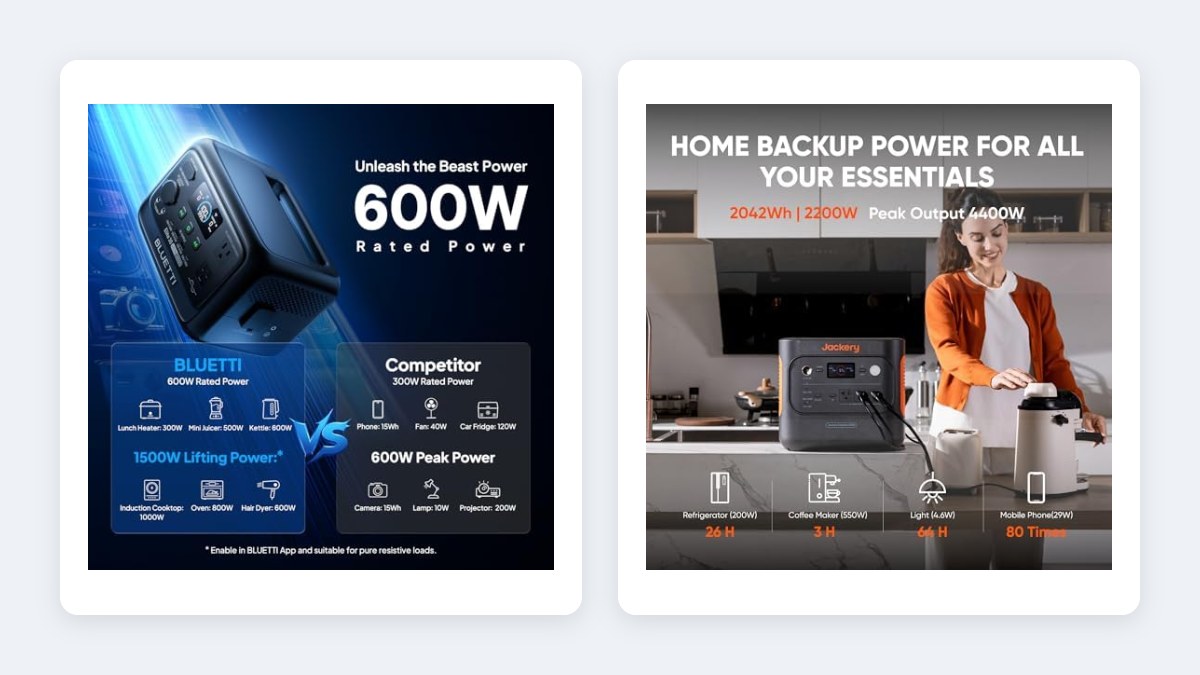
Watt-hours (Wh) determine how long you can run something; watts (W) determine what you can plug in at all. A power station can have plenty of capacity but still fail to start a device with a high startup surge if its output rating is too low. Always check both numbers against what you actually plan to run, not just the headline capacity figure.
LiFePO4 vs. Older Lithium-Ion
Every unit in our comparison uses LiFePO4 (lithium iron phosphate) battery chemistry, which is now the standard for portable power stations because it holds far more charge cycles than older lithium-ion batteries before capacity degrades — typically 3,000+ cycles vs. 500–800 for older chemistry.
UPS Switchover Time Matters for Home-Office Backup
If you want a power station to keep a computer or router running through a power blip, check for a specifically stated UPS switchover time (some units, like the BLUETTI Elite 30 V2, market a 10ms switchover). Not every “backup power” unit switches over fast enough to prevent a computer from rebooting.
Charge Speed Varies Widely
Full recharge times in our comparison ranged from about 45 minutes to over an hour for similarly sized units — a meaningful difference if you’re relying on grid power between outages or trying to top up between uses on a trip.
Solar Compatibility
Most current units, including every one in this guide, support solar charging, but solar panels are almost always sold separately and add significant cost. Check panel wattage compatibility before assuming any solar panel will work at full speed.
Review Volume vs. Rating
A 4.7-star rating built on 3,600+ reviews (Jackery Explorer 1000 v2) is a far more reliable signal than the same or even higher rating built on a few hundred reviews from a newer model. Flagship units are sometimes newer releases with less review history than their smaller, longer-selling siblings.
How to Size a Power Station for Your Needs
The quickest way to choose a capacity is to estimate runtime. Take the battery’s watt-hours, multiply by about 0.85 to allow for conversion losses, then divide by the wattage of what you want to run. A 1,000Wh unit running a 60W laptop works out to roughly 1,000 × 0.85 ÷ 60, or about 14 hours.
Typical power draws to use in that calculation:
| Device | Typical draw |
|---|---|
| Phone charging | 10–25W |
| Wi-Fi router and modem | 10–25W |
| CPAP machine (no heated humidifier) | 30–60W |
| Laptop | 45–100W |
| LED TV | 50–150W |
| Full-size refrigerator (average over a day) | 100–200W, with a much higher startup surge |
| Microwave, kettle, space heater | 1,000–1,500W+ |
These are rough ranges. Check the label on your own devices for exact figures. As a rule of thumb, 250–300Wh units suit phones, laptops and camping lights; 1,000Wh units can keep a fridge, router and lights going through a typical outage; and 2,000Wh and up is for longer outages or running several appliances at once.
Surge Power and Pure Sine Wave Output
Motors and compressors, like those in fridges, pumps and power tools, draw several times their running wattage for a second when they start. Many power stations list a separate surge or peak rating for this. If a device trips the unit’s overload protection, the surge rating is usually the reason.
All the major brands now use pure sine wave inverters, which produce clean power similar to a wall outlet. That matters for sensitive electronics, CPAP machines and anything with a motor. Avoid very cheap no-name units that use modified sine wave output.
Weight and Portability
Capacity adds weight quickly. Small 250–300Wh units are light enough to carry with one hand, 1,000Wh units are a two-handed lift, and 2,000Wh units are heavy enough that wheels or a fixed spot at home make sense. If you plan to carry it to campsites, check the weight before you check the capacity.
Ports and Expansion
Count the AC outlets and USB-C ports you actually need. High-wattage USB-C (60–100W) can charge most laptops directly, without the conversion losses of using the AC outlet and a laptop brick. Some larger units also accept add-on expansion batteries, which lets you start smaller and add capacity later.
Storage and Safety
- Unlike gas generators, power stations produce no fumes, so they are safe to use indoors.
- For storage, keep the battery partly charged and top it up every few months, so it is ready when an outage hits.
- LiFePO4 batteries should not be charged below freezing. In winter, bring the unit indoors before recharging it.
- Keep the vents clear while charging or running high loads.
Frequently Asked Questions
Can a portable power station run a refrigerator?
A unit of around 1,000Wh with enough surge capacity can usually run a modern fridge for several hours. Use the runtime formula above with your fridge’s rated wattage.
Can I use it while it is charging?
Most current models support pass-through charging, meaning you can charge the station and power devices at the same time. Check the listing to confirm.
Is it a replacement for a gas generator?
For short outages and indoor use, often yes. For multi-day outages running heavy appliances, a generator or a large battery system with solar is still more practical.
Bottom Line
Match capacity and output to your actual use case — small electronics need far less of both than home backup — and don’t assume a bigger, more expensive unit is automatically the better-reviewed one.
Related Guides
Ugo Daniel researches, compares, and writes the buying guides on Wallstores, cross-checking manufacturer specs, verified pricing, and real customer feedback across tech, home, fitness, and pet categories. He’s personally bought and used many of the kitchen appliances featured on the site, and draws on that firsthand experience in those reviews.